
25/08/2026
CRM vs ERP: Key Differences and How to Choose by Company Size
Compare CRM and ERP by goals, data, users, and implementation scope, then choose the right system for your company size and growth stage.


Business digital transformation does not begin with buying more software. It begins with practical questions: which processes waste the team's time, where data is fragmented, and which decisions need to be made faster?
A sound roadmap moves the business from manual work to connected systems, automation, and AI through measurable stages. This guide explains a practical approach for growing companies while avoiding technology investments that do not create real value.
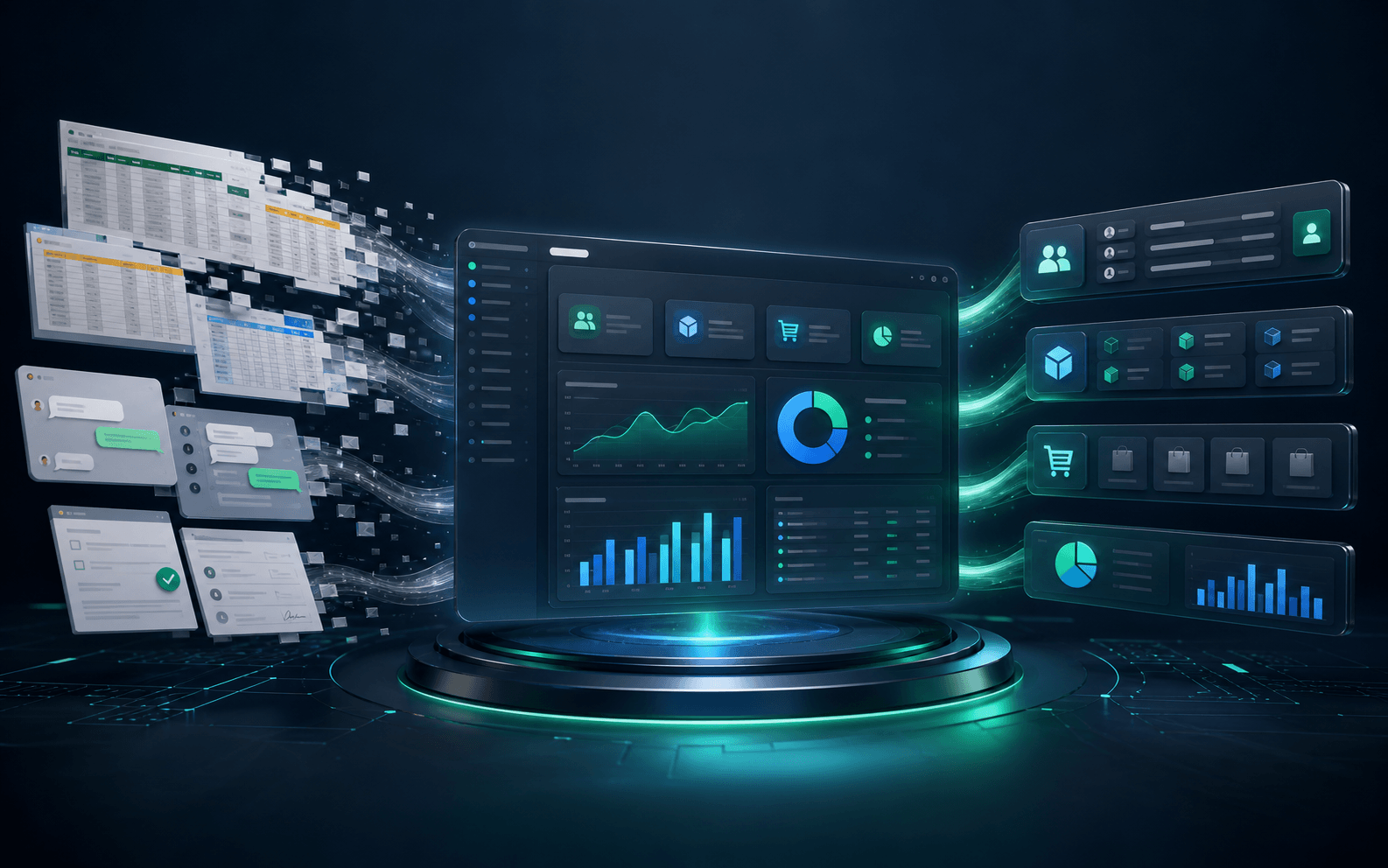
Business digital transformation is the redesign of operations using data and technology. The goal is not merely to digitize documents, but to create a unified way of working where data is updated in the right place, tasks move automatically, and managers have timely information for decisions.
The journey can be viewed in three levels:
Digital transformation should become a priority when one or more of these signs appear:
You do not need to wait until the problems become severe. A small, frequently repeated process is often the best place to create an early win.
Start with a business result, not a technology name. A useful goal might be to shorten order processing, reduce data entry, improve on-time customer responses, or give managers a daily operational view.
Each goal needs a baseline and a target. This is how the business can distinguish genuine impact from a simple change of interface.
List every step from request to completion, including owners, inputs, approvals, and common exceptions. Prioritize processes that are frequent, have meaningful impact, and can be improved within a controlled scope.
A good pilot is small enough to complete quickly and important enough for the team to notice the difference.
Data is the foundation of automation and AI. Agree on definitions for customers, products, work statuses, revenue, and other critical fields. Establish who may view, create, edit, or export each type of data.
Resolve duplicates, missing values, and inconsistent formats. Otherwise, the new system will only make old errors move faster.
Depending on the need, a business may introduce enterprise management software, CRM, ERP, an internal portal, a website, or a custom application. The architecture should support API integration, clear permissions, audit trails, and phased growth.
Not every feature needs to be built from scratch. Effective solutions often combine proven products with custom modules for workflows that create competitive advantage.
Once data and processes are stable, the business can automate notifications, task creation, data synchronization, rule checks, reports, and work handoffs.
Begin with transparent rules that are easy to test. Every automated flow should have an owner, processing logs, and a way to handle exceptions.
AI integration for business works best on a foundation of trusted data and clear processes. Suitable use cases may include classifying customer requests, summarizing documents, drafting responses, searching internal knowledge, or forecasting demand.
Before scaling, evaluate accuracy, cost, privacy, and human review. AI should support decisions rather than turn an uncontrolled process into a black box.
Interview users, measure current processing time, map the workflow, and select a pilot. Define the goal, metric, data requirements, and integrations.
Design the experience, configure or develop the module, clean the data, and test with a small user group. Prioritize the core workflow before secondary features.
Train the team, launch the workflow, monitor issues, and compare results with the baseline. Expand only after the pilot is stable and its value can be demonstrated.
Yes, but the scope should remain manageable. Small businesses often benefit first from centralizing customer data, standardizing sales workflows, and automating repetitive administrative tasks.
Off-the-shelf software suits common processes and fast deployment. Custom software is valuable when a distinctive workflow creates competitive advantage or deep integration is required. Many businesses get the best result from a combination of both.
When the business has a defined problem, sufficient data quality, and a way to evaluate the output. If these conditions are unclear, standardize the data and process first.
Sustainable digital transformation is a deliberate sequence: understand the process, standardize data, build the platform, automate, and then scale AI. Starting small helps the business learn faster, control risk, and prove value before making a larger investment.
AgentTech provides business software and AI integration services through a flexible roadmap. If you need help choosing the right starting point, request a consultation to assess your process and plan the next steps.
Compare CRM and ERP by goals, data, users, and implementation scope, then choose the right system for your company size and growth stage.

Nine practical business AI use cases, from customer support and document processing to forecasting, workflow automation, and internal knowledge assistants.
Compare off-the-shelf and custom enterprise software, recognize when a tailored solution is justified, and follow a lower-risk implementation roadmap.

Business digital transformation does not begin with buying more software. It begins with practical questions: which processes waste the team's time, where data is fragmented, and which decisions need to be made faster?
A sound roadmap moves the business from manual work to connected systems, automation, and AI through measurable stages. This guide explains a practical approach for growing companies while avoiding technology investments that do not create real value.
Business digital transformation is the redesign of operations using data and technology. The goal is not merely to digitize documents, but to create a unified way of working where data is updated in the right place, tasks move automatically, and managers have timely information for decisions.
The journey can be viewed in three levels:
Digital transformation should become a priority when one or more of these signs appear:
You do not need to wait until the problems become severe. A small, frequently repeated process is often the best place to create an early win.
Start with a business result, not a technology name. A useful goal might be to shorten order processing, reduce data entry, improve on-time customer responses, or give managers a daily operational view.
Each goal needs a baseline and a target. This is how the business can distinguish genuine impact from a simple change of interface.
List every step from request to completion, including owners, inputs, approvals, and common exceptions. Prioritize processes that are frequent, have meaningful impact, and can be improved within a controlled scope.
A good pilot is small enough to complete quickly and important enough for the team to notice the difference.
Data is the foundation of automation and AI. Agree on definitions for customers, products, work statuses, revenue, and other critical fields. Establish who may view, create, edit, or export each type of data.
Resolve duplicates, missing values, and inconsistent formats. Otherwise, the new system will only make old errors move faster.
Depending on the need, a business may introduce enterprise management software, CRM, ERP, an internal portal, a website, or a custom application. The architecture should support API integration, clear permissions, audit trails, and phased growth.
Not every feature needs to be built from scratch. Effective solutions often combine proven products with custom modules for workflows that create competitive advantage.
Once data and processes are stable, the business can automate notifications, task creation, data synchronization, rule checks, reports, and work handoffs.
Begin with transparent rules that are easy to test. Every automated flow should have an owner, processing logs, and a way to handle exceptions.
AI integration for business works best on a foundation of trusted data and clear processes. Suitable use cases may include classifying customer requests, summarizing documents, drafting responses, searching internal knowledge, or forecasting demand.
Before scaling, evaluate accuracy, cost, privacy, and human review. AI should support decisions rather than turn an uncontrolled process into a black box.
Interview users, measure current processing time, map the workflow, and select a pilot. Define the goal, metric, data requirements, and integrations.
Design the experience, configure or develop the module, clean the data, and test with a small user group. Prioritize the core workflow before secondary features.
Train the team, launch the workflow, monitor issues, and compare results with the baseline. Expand only after the pilot is stable and its value can be demonstrated.
Yes, but the scope should remain manageable. Small businesses often benefit first from centralizing customer data, standardizing sales workflows, and automating repetitive administrative tasks.
Off-the-shelf software suits common processes and fast deployment. Custom software is valuable when a distinctive workflow creates competitive advantage or deep integration is required. Many businesses get the best result from a combination of both.
When the business has a defined problem, sufficient data quality, and a way to evaluate the output. If these conditions are unclear, standardize the data and process first.
Sustainable digital transformation is a deliberate sequence: understand the process, standardize data, build the platform, automate, and then scale AI. Starting small helps the business learn faster, control risk, and prove value before making a larger investment.
AgentTech provides business software and AI integration services through a flexible roadmap. If you need help choosing the right starting point, request a consultation to assess your process and plan the next steps.
Compare CRM and ERP by goals, data, users, and implementation scope, then choose the right system for your company size and growth stage.
Nine practical business AI use cases, from customer support and document processing to forecasting, workflow automation, and internal knowledge assistants.
Compare off-the-shelf and custom enterprise software, recognize when a tailored solution is justified, and follow a lower-risk implementation roadmap.